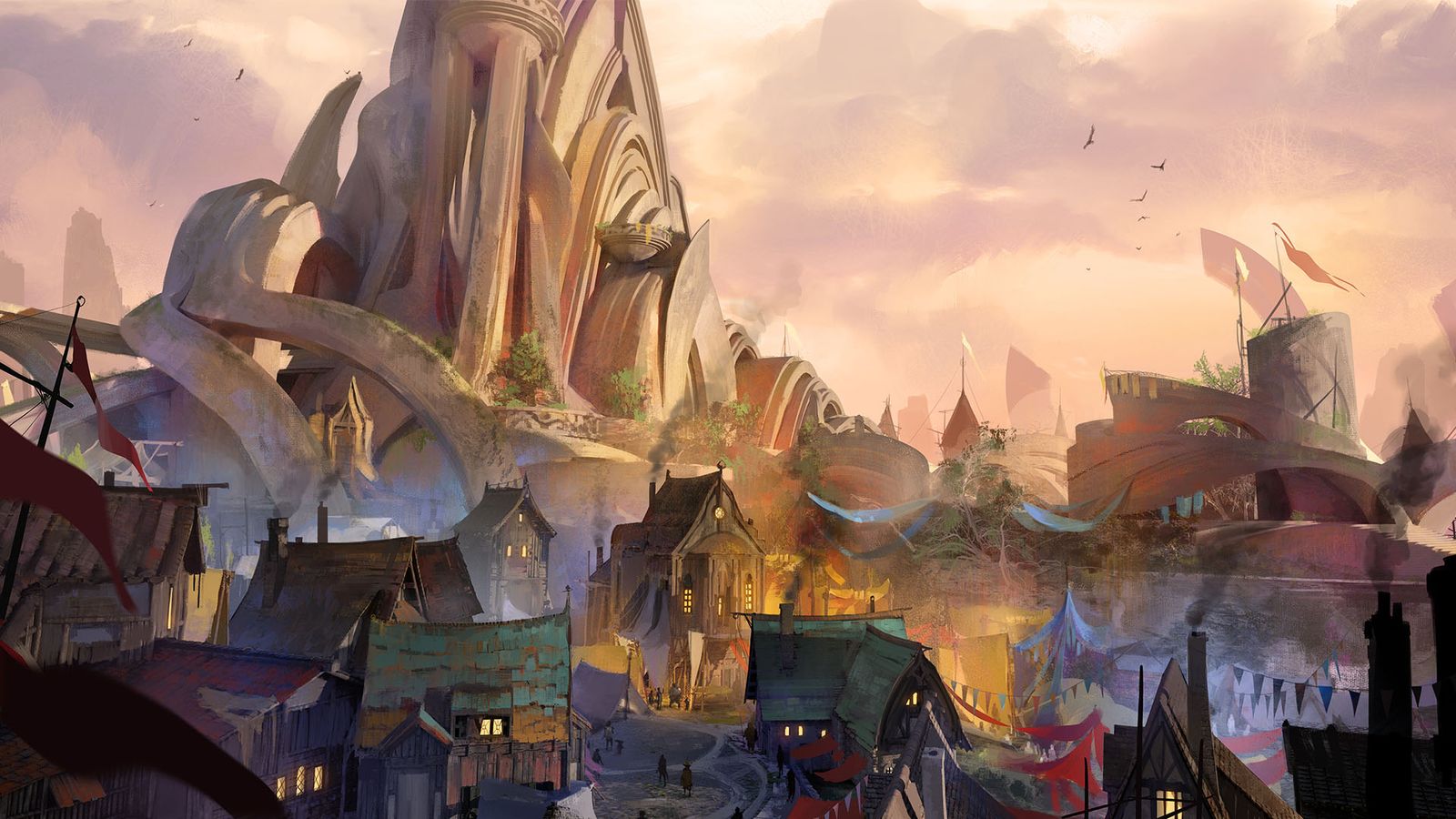
Greetings, Tyrians! This is Aaron Linde of the Guild Wars 3™ narrative team. Now that we've had a chance to get acquainted with most of our playable species (we'll be ready to introduce the fourth in December) and the Mavenwrights, today we're excited to talk about the lore behind our first major player social hub, Warden's Watch. One of the oldest settlements in Orr, it acts as the seat of operations for the Vaelwardens in Tughra Basin.
To a warden returning from long weeks in the wilds, few sights are as welcome as the banners of Warden's Watch rising over the horizon. Built in and around the bones of a dormant Forgotten tower, the Watch is where Orrian guilds come to rest, resupply, and trade news, and where the farmers, traders, and laborers of this rural reach of Orr make their living alongside them. It is, in every meaningful sense, home—but ask any warden, and they'll tell you they wish it had never needed to exist. The Watch was born of necessity: the Order of the Vael's answer to the greatest tragedy to befall Orr in living memory.
Orr Thulon and the Founding Heresy of the Vaelwardens
Of all the spirits that have ever dwelled in Orr, none so embodied the Vael's richness and splendor as Orr Thulon, a colossal aerial spirit that held dominion over the region for millennia. To those who worshipped it, Orr Thulon was as eternal and unchanging as the magical wilds it protected. That belief would be shattered in 205 BE, shortly after humanity's arrival in Orr.
On an otherwise uneventful evening, a clash erupted over Tughra Basin so cataclysmic that it could be seen for miles; a battle of such proportion that few of this era had seen with their own eyes. When at last Orr Thulon was struck down, the blow scoured the land beneath it, leaving a vast swath of Tughra Basin as a charred expanse devoid of all natural and magical life that remains to this day. Yet the impact paled in comparison to what followed: a torrent of stored magic that erupted from the great ancient's mask for hours before giving way to a chilling silence. Orr Thulon was dead, and the Vael had suffered its first great wound. It would not be the last.
The Vael ancient's allies raced to the site of Orr Thulon's slaying and found the newly made desert still smoldering, swept by howling sandstorms driven by ungoverned magic that now coursed ceaselessly through the land. With Melandru's aid, they set about healing the wounded earth, and she offered the fledgling order use of an old Forgotten tower just west of where the great spirit fell. Though never deliberately named, this foundation, built up over time by the many arrivals to Orr that would follow, would come to be known as Warden's Watch.
A Centuries-Long Vigil Begins
Like the rings of an old tree, Warden's Watch wears its history openly. The settlement has grown outward from its original foundation in layers, each laid down by a different chapter of the order's long vigil. Start at the center and walk outward, and you're taking a trip forward through time: the farther you stray from the heart of the Watch, the more recent the construction.
At the very center stands the Forgotten tower itself. In the time of Guild Wars 3, the specific Forgotten who raised it remain a profound mystery; who they were and what they intended are questions the scholars of Orr have scarcely begun to investigate. But for the folks who live and labor in the Watch, the tower is simply part of the scenery; like the oldest landmark in any town, it's always been there, and so it hardly invites a second glance from the locals.
Encircling the tower are the order's own facilities, in operation since the guild's founding. First is the headquarters from which the guild's envoy—or the interim guild envoy, as the current holder of the post would double underline—directs the order's affairs and coordinates with the High Council of Arah on matters of governance across greater Orr. Then the Vaelwarden quartermasters and their artificing stations, where wardens maintain and refine their signets and weapons. Finally, not least of the Vaelwardens holdings, the tavern where guild members returning from months in the wilds can finally set down their burdens, at least for an evening.
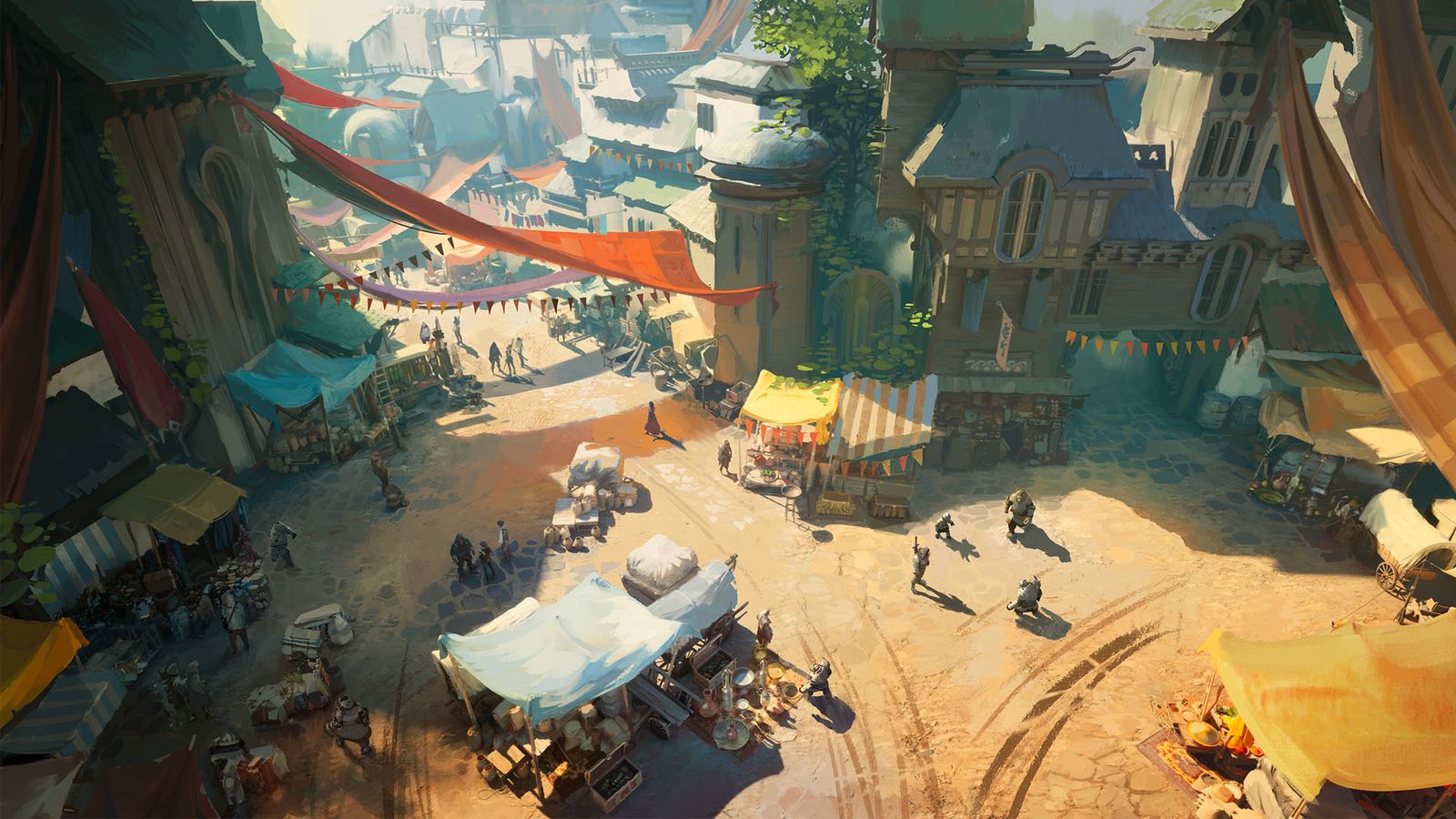
Beyond them lie the layers laid down by those who came after: the homesteads and workshops of the kodan, asura, and human settlers who have made the Watch their home. Just off the main thoroughfare stands a kiln the Mavenwrights once operated, back when they still held a charter and still worked alongside the order. Since the guild's disgrace, the kiln has been abandoned and repurposed by other residents of the Watch. The Accords that bind the guilds of Orr strictly forbid armed conflict within the Watch's bounds, but with the fighting between the wardens and the Mavenwrights at a fever pitch, the warden and Zaishen guards stationed around the Watch have taken a simpler approach: Mavenwrights are no longer permitted inside at all.
The newest ring sits on the outskirts of town and hosts facilities used by other guilds and a temple of the Church of the Six, built somewhat recently in the history of the Watch. Ostensibly a place of worship honoring the whole of the human pantheon, each god equal in portrayal and presence, the church functions in practice as the political and clerical arm of Arah in greater Orr. For the many Orrians without a seat at the high council or direct access to Arah—which is to say, most Orrians—its clergy are the only direct line to the gods most will ever have, and its temples are the first stop for settling disputes between guilds before they reach the council itself.
That one now stands at Warden's Watch says a great deal—for most of its history, Tughra Basin has been a rural backwater, far from Arah's gaze. The temple's arrival suggests that the gods have, at long last, turned their eyes toward the Watch. A sign that the basin is no longer the edge of the map, but a fully fledged part of greater Orr.
Keeping the Watch
So many years after the order first made camp in the shadow of the Forgotten tower, Warden's Watch has become something its founders could scarcely have imagined: a true town, alive with farmers and traders, kodan and asura and human, and now even a temple bearing the favor of Arah. The Watch has grown far beyond the vigil that inspired its founding. And though the banners of the Order of the Vael still fly high over Warden's Watch, to many, they're heralds of a passing age.
Over pub tables and market stalls, a question is asked more often, and more quietly, with each passing season: What is the Watch without its wardens? The order's ranks thin year by year. The scoured desert at the Watch's doorstep has never truly healed. Other guilds representing less lofty interests—such as trade, commerce, and husbandry—are beginning to organize, and while some are much-needed allies to the Vaelwardens, others feel they're assuming a burden the order is no longer equal to. Mavenwright raids grow bolder, and the Vael's wounds continue to mount.
For now, the banners remain. Born of the order's greatest loss, the Watch remains the only true home the Vaelwardens have ever known in Orr, and the last place they can still call their own. How much longer those banners fly is up to you and those like you: the last of the guardians of holy Orr and the spirits who dwell there.