Hello, Guild Wars® community! 

Today's Guild Wars 3™ update is a big one, as I'm going to be talking about the core philosophy that defines the way we make games. So grab a cup of your favorite drink, sit back (or lean forward), and relax…it's reading time.

When we set out to build Guild Wars 3, we didn't start by asking what a sequel should look like. We started with something more fundamental: the core philosophy that defines how we have built games at ArenaNet over the last twenty-one years. Our philosophy is relatively simple. When we make a new game, we take an inventory of the genre at the time—the good and the bad. Then, we identify player problems, frustrations, and limitations and we ask: how could we solve them?  

A colorful and bustling marketplace scene.

Today, I'm going to talk about four core elements players have come to know and love about Guild Wars games that arose from this approach to game development. These are expectations we know players have of any Guild Wars game as a result of the innovations we've delivered on over the years, and I want to share how we're applying those expectations to Guild Wars 3.

1. No subscription fees. 

From the beginning, one of the defining ideas behind Guild Wars was simple: players should be able to buy the game and play it on their own terms. When Guild Wars launched in 2005, that wasn't the norm. Subscription fees were a core part of the MMO model. Choosing not to have one wasn't just a pricing decision; it was a statement about accessibility and long-term value. We carried that forward into Guild Wars 2®, and it remains just as important today. 

Guild Wars 3 will be a buy-to-play game at release. There will be no subscription fee. 

That model matters because it puts players in control. Our goal is for players to feel like their time in the game is something they choose, not something they owe. Want to take a break and go play other games? Great, go for it! (We'd recommend trying out Guild Wars Reforged and Guild Wars 2; we hear they're awesome.) Ready to come back when the next Guild Wars 3 expansion comes out? Wonderful, we'll be here waiting for you.  

But just saying there won't be a subscription fee isn't enough anymore. We've been looking carefully at the newest round of modern MMOs and the broad array of live-service games (that often look suspiciously like MMOs) and seeing how subscription-like systems have evolved.  

In manynewergames, the subscriptionhasn'tdisappeared;ithasbeen reshaped. Paid battle passes, paid recurring seasonal tracks, and similar paid systems often function as a new kind of ongoing fee.

That model works for some games, but it's not aligned with how we think about player freedom in a Guild Wars game. It's a form of subscription fee, hidden inside of a neat "optional" package that obfuscates the subscription from the player.  

When we say Guild Wars 3 won't have a subscription fee, we mean it. No monthly fees and no battle pass subscription fees. Just buy the game and play when you want. If we earn your trust and you feel we're delivering experiences you love, we'll have expansions and other things you can buy from us if you think they're worth your investment.  

2. No pay-to-win. 

Speaking of other things you can buy from us, this one is pretty simple, and the statement we made before the release of Guild Wars 2 about our philosophy in this area remains true to this day. 

We think players should have the opportunity to spend money on items that provide visual distinction and offer more ways to express themselves. They should also be able to spend money on account services and on time-saving convenience items. But it's never okay in a Guild Wars game for players who spend money to have an unfair advantage over players who spend time.

3. Respecting your time and investment.

Respecting players' time has always been a core part of Guild Wars, and that's more important today than ever before. One of the most common perceptions about the MMO genre is that the games require massive time investments to play.  

Historically, MMO engagement has been viewed as an experience like a second job, where players spend large amounts of time preparing to have fun before they can actually engage in the fun parts. Only have thirty minutes to play? Don't play an MMO; you'll need that time just to organize your inventory, figure out what content you're going to play, get your character set up, and—oh, no! Time's up, and you haven't even begun the gameplay yet.  

Players today have more choices than ever. And so many modern game experiences allow players to quickly and meaningfully get a return on their time investment in the game without significant barriers or preparing to have fun. That means our responsibility isn't just to create content; it's to make sure that time spent in the game feels meaningful. This has always been important to ArenaNet in the Guild Wars franchise, but we're continuing to evolve this philosophy for the modern era of game development and asking how a genre that is dominated by ten- to twenty-year-old games modernizes this space. 

We want you to feel good about the time you invest, whether you're playing every day, only have an hour or two every week, or are coming back after a long break from the game.  

For our existing fans, we've already announced there will be a new Hall of Monuments that connects your Guild Wars 2 account to your Guild Wars 3 account and provides a wide array of awards as our means of saying thank you and showing we respect the time and investment you've already made in the franchise. 

We'll talk in more detail in the future about how Guild Wars 3's game and content systems are evolving to create a new take on the MMO that respects players' time and investment.  

4. Innovating and evolving the MMORPG genre.   

One of the most important parts of our philosophy—and one that sometimes surprises people—is that we don't aim to make direct sequels. Guild Wars and Guild Wars 2 are very different games, and that was intentional. Though they take place in the same world, each one was built to push against the conventions of its time, solve player problems relevant to that era of games, and explore new ideas in the MMO space. 

The MMO landscape today isn't the same as it was during the development of Guild Wars or Guild Wars 2. Player expectations have changed. Technology has evolved. The ways people engage with online worlds are broader and more varied. The lines between an MMO and a live-service game have blurred. The amount of time players have to dedicate to a single game has decreased as their library of games has continued to grow. 

If we approached Guild Wars 3 by simply extending what we've already done, we'd miss the opportunity to move the genre forward; a genre that we've heard so many of you say desperately needs innovation and evolution. So instead of just making a sequel, we're asking the same question we always do: 

What does the next evolution of an MMO look like right now? 

Answering that question meansGuild Wars 3 will be its own kind of gamedistinct from both Guild WarsReforgedand Guild Wars 2.Our two existing games fall on the two furthest ends of the MMORPG spectrum:

Guild Wars Reforged is, at its core, a game about a small team: a player and their assembled team of henchmen or hero NPCs or other players they want to bring along with them, overcoming challenges in a predominantly instanced game. Unless you invited them along, you never saw other players except in the game's social hubs. When we released the original Guild Wars, we branded the game as a CORPG (cooperative online RPG); however, the branding never stuck, and everyone informed us we'd released an MMORPG. We even won multiple MMO-of-the year awards! We gave up on the CORPG angle since it didn't stick with players, and we simply embraced what everyone told us: we'd shipped a unique kind of MMORPG.

Guild Wars 2 is the opposite. At its core, it's a game about giant-scale experiences in an expansive open-world setting. Giant world boss battles, map-wide meta-events, and PvP on a massive scale are what Guild Wars 2 is most known for, although the game offers a wide array of different experiences. Unlike other large-scale MMO worlds, there are no servers or worlds you join that restrict the players you might meet within that giant setting; instead, the game is organized into maps using our megaserver system, and players are able to play with anyone who chooses the same region of the real world they play the game from.

Guild Wars 3 lands near the middle of the MMO spectrum, which supports the goals we have for our movement and combat systems. While it fits the definition of an MMORPG significantly more than Guild Wars Reforged does, it doesn’t try to replicate the large-scale gameplay pillars that so uniquely define Guild Wars 2. This ensures that all three of our games can coexist as different experiences on different timelines, telling different stories about the world of Tyria.

I realize this is (intentionally) somewhat broad and vague, and you all want to know a lot more about the specifics of what all of this means right now. But we've got a very long campaign ahead of us between now and the launch of Guild Wars 3, and there's plenty of time. We'll discuss the specifics in much greater detail in the future as we share more information on the various game systems, content systems, and concepts that make up Guild Wars 3.

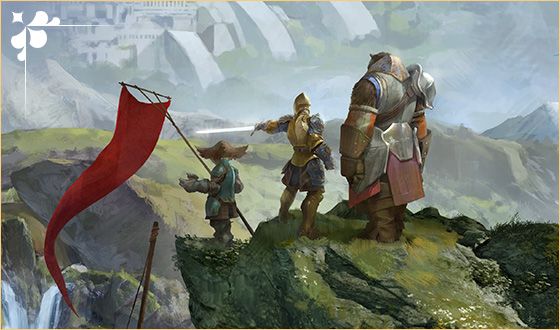
An adventuring party stands on a vista, looking at an expansive horizon.

Looking Ahead 

As we continue development, these pillars are our foundation. They shape not just individual features, but the overall direction of the game. 

You'll see us come back to them often in the future when we discuss the game in more detail. And, as always, player feedback will be a big part of that process. We only know we've solved player problems when you tell us our solutions are working.  

Guild Wars has always been a conversation between developers and the community. That doesn't change with Guild Wars 3.  We invite you to join that conversation on our social channels and our newly launched official Guild Wars community Discord server

The conversation has just begun; we can't wait to share where we're going!  

—Colin Johanson