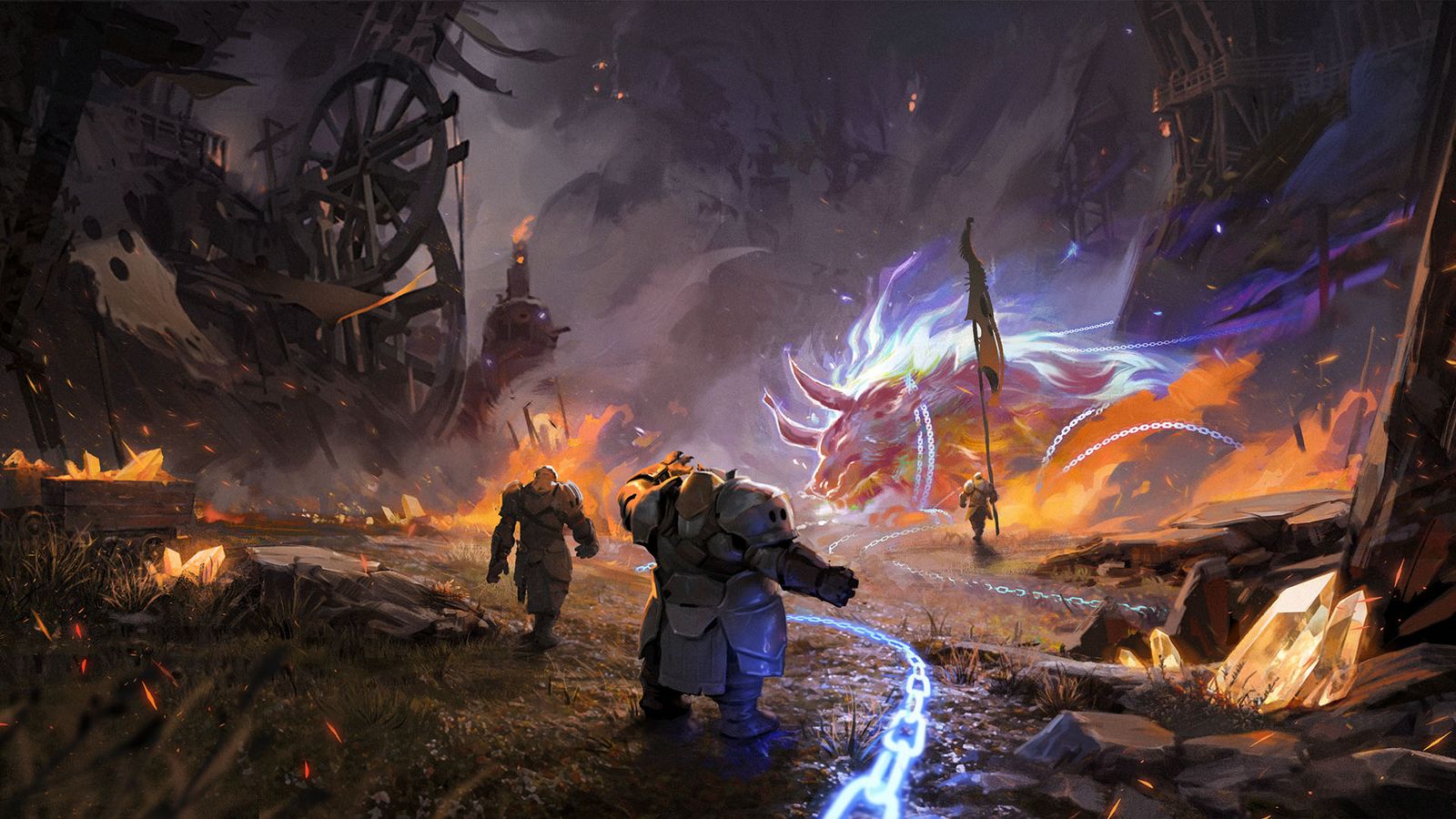
Hello, Tyrians! This is Narrative Designer Anatoli Ingram and Guild Wars 3™ Narrative Lead Aaron Linde. Today, we'll pull back the curtain a bit more on one of the guilds that defines the Orrian golden age.
Just like in Guild Wars 2®, our goal for Guild Wars 3 is to design gameplay that will always make meeting another player in the world a positive experience. But not every inhabitant of Orr will be as thrilled to see you coming their way; at this late stage in their history, the Vaelwardens are not without their enemies.
Chief among those rivals are the Mavenwrights: a human-founded guild of builders and industrialists set on capturing the awesome might of the Vael for their own use, firm in their belief that magic will be the engine that uplifts all of humanity into a future beyond imagining. Their rivalry with the Order of the Vael is deadly serious, and it has reached a fever pitch in the months directly preceding the start of Guild Wars 3.
Clashes between the Mavenwrights and the Vaelwardens have escalated into open conflict across the wilds of Orr, sparked by disputes over weapon smuggling, environmental destruction, and assaults on the spirits of the Vael.
As far as the Mavenwrights are concerned, every warden eliminated is one less obstruction standing before the march of progress.
Making of the Mavenwrights
Formed just over twenty years before the start of Guild Wars 3, the Mavenwrights' early history was mired in controversy well before they were ever chartered as an official guild of Orr.
Their founder, Ricken "the Hammer” Oberon, came of age in Callen's Way, a small settlement built along a mercantile low road connecting Tughra Basin with southern Orr and beyond. Like many highway towns, the lifeblood of Callen's Way was the merchant traffic passing through it; when new and more efficient routes northward drew that traffic elsewhere, the community fell into disrepair.
By the time he was grown, Oberon knew his wayward community needed a renewed vision, something to reach for and build toward. Lured by tales of the majesties and bounties of the Vael, Oberon bid to make his own fortune via land grabs in the wilds across Tughra Basin, bringing him into direct conflict with both the Order of the Vael and the Vael spirits themselves.
But his few successful attempts—and the valuable magical resources flowing into Callen's Way—convinced him that a path to the future led directly through the Vael. The capital generated by these initial ventures made the founding of the Mavenwrights possible, and Oberon's operations expanded swiftly.
The Mavenwrights enjoyed overwhelming support from traders and business magnates eager to align with a guild that might test the wardens' jurisdiction over the Vael and its vast, untapped resources. Their experiences with Oberon and the master crafters he managed were productive—he could be arrogant and ill-tempered, but he'd earned his reputation by building homes and lodgings, fortifying infrastructure, and establishing trade and supply routes throughout the Orrian countryside. He quietly promised them new markets to explore, advancements in manufacturing, and—most exciting of all—potentially unlimited access to magic.
The Mavenwrights were officially chartered as a crafters' guild, which granted them considerable autonomy to gather resources and undertake projects in Tughra Basin and allowed limited use of signets for defense and labor. For most Orrian guilds in this era, these privileges came with certain responsibilities—an understanding that the Mavenwrights would collaborate with other guilds, including the Order of the Vael, to see to the collective stability and security of the region.
And they did, for a time.
Irreconcilable Differences
The exact reason the Mavenwrights lost their guild charter differs sharply depending on the source. Ask a Vaelwarden, and they'll tell you that it was far too long in coming; the steady accumulation of grievances against the Order of the Vael was so severe that not even the gods in Arah could ignore them any longer.
The Mavenwrights would argue that the order's influence in Orr was already so far eroded that they lashed out at the first hint of a challenge, slandering the master artisans who had built homes, bridges, and infrastructure across Orr as hostile invaders. By their reckoning, the rapid growth of the Mavenwrights told of a realization spreading among the commoners of greater Orr: that the Vaelwardens wanted them to live like trespassers on their own lands, furtive and ashamed.
The specifics of the Mavenwrights' fall are known only to the gods, but the practical impacts of the High Council's decision were powerful and far reaching. Cut off from access to signet artificing, the Mavenwrights sought to rebuild their access to magical resources and armaments by other means. They redoubled their efforts to reap the bounties of the Vael in the wildlands and created a vast smuggling network to traffic signet-bearing weapons to black markets throughout Tyria. And they began experimenting with signet artificing on their own, repurposing signets into novel (and at times unreliable) applications. They even developed contraptions that forcibly extract Vael magic, such as the deadly flamethrowers wielded by Mavenwright burners; a captured Vael sprite empowers each one.
An Ongoing Conflict
The Mavenwrights have hardly missed a step since the gods' verdict was handed down. The revocation of their charter was meant to rein them in, but it came too late; despite their continued abridgements of the laws of Arah and repeated pleas from the Vaelwardens for intervention, the guild's leadership has yet to be summoned before the High Council to face consequences. Whispers of some lofty concern drawing the gods' attention away from Orr suggest that it may be some time before the council will convene again. Many wonder whether the Order of the Vael will still exist by the time it finally does.
In the meantime, the Mavenwrights have little to lose by resorting to open banditry; they've been buying and selling signets under the table for years, to say nothing of the resources stolen from settlements or violently ripped from the Vael. But recently, more of those materials are going to the Mavenwright warehouses than markets abroad. The Order of the Vael may be suffering for recruits, but the weapons they wield still far outclass any the Mavenwrights—or any of the other guilds of Orr, empowered or otherwise—can fashion themselves.
A feverish effort is underway to develop alternative weaponsmithing and signet-crafting techniques to replenish the disgraced guild's armory and empower them further. However, the magical weapons they've successfully produced to date can only accommodate a single signet, putting their wielders at a stark disadvantage against armed Vaelwardens. Though they've made numerous attempts to replicate the Vaelwardens' signet-setting techniques, they have not yet succeeded, much to Oberon's frustration.
Most Mavenwrights are human, but it's not unheard of for other species to join. Individual reasons vary; regard for the Vael is not universal even among the kodan, and the Mavenwrights are always offering paying work to any seeking it, from any walk of life. Although they still claim to be a guild of master crafters first and foremost, at the highest levels the Mavenwrights are driven by ideology: a belief that the Vael and all it encompasses belongs to the people most willing to exploit it in the name of progress.
Public opinion hasn't yet turned against the Order of the Vael, but every warden dreads seeing a familiar face among the malcontents: a farmer dispossessed when the massive Vael ancient Ironroot shifted unpredictably; a once-friendly trader who found deeper pockets in Callen's Way than in Warden's Watch; a disillusioned youth who used to run to meet them on the road just to pat their Seekers. Every defection to the Mavenwrights reminds the Vaelwardens where they're stretched too thin to offer good alternatives to bad decisions.
If the Mavenwrights aren't yet able to overpower the Vaelwardens, they can at least outnumber you—and make swearing an oath to defend the Vael as dangerous as possible.